
The Last Gas Before the Long Empty
At the edge of the Great Basin, one station stands in the wind, and the sign on its wall says what a full tank is for.
The click comes up through the pump handle into the heel of my hand — a solid thunk — and the numbers on the little screen stop turning. I stand there a second longer than I need to, feeling the tank go solid under the truck. The hose goes back into its cradle with a metal clatter, and then the wind has the lot to itself again.
It is always windy here. The wind comes down off the Great Basin with nothing to slow it, crosses the gravel lot, and works the flag against its pole until the pole hums. The thin trash — a receipt, a straw wrapper, someone's drink lid — makes its way from the pumps to the fence and back again. The air smells of gasoline, dust, and faintly of the coffee inside, and if you didn't know better you'd say nothing alive had ever been this far from the coast.
I do this the same way every time. Pull in, nose the truck at the middle pump, the one closest to the door for no good reason. Set the catch and let it run while I stand with my hands in my pockets and watch the numbers climb. The click always comes sooner than I remember. I have made this drive often enough to know the math, and I never believe it until the handle clicks off.
The wind takes my jacket as I walk around to the side of the building. That's where the sign lives.
The Sign
The sign is a white board bolted to the side wall, years of dust ground into the paint, with black stick-on letters that someone keeps replacing when the wind steals one. It gives the miles to the next station on the dry side of the pass: the town's name in letters, the number beneath it, and under that a smaller line saying the place closes early in winter. I have read that sign more times than I can count, and I still read it every time, the way you reread a line you already know by heart.
A letter went missing once, off the town's name, and for weeks the sign named a place that didn't exist. Nobody seemed to care. It still meant the same thing.
The miles are what they are. What the sign does not say is what they mean: that from this lot on, every mile is a mile that has to be answered for. No gas well off the side. No cluster of lights promising a stop you'd forgotten about. Just the road, the next sign long hours ahead, and whatever you brought along in the tank and in the cab.

I do the arithmetic anyway, standing with my back to the wind. The tank holds what it holds. The gauge reads what it reads. The answer comes out the same as it did last time and the time before. It is a habit from the first crossing I ever made, the year I learned what that sign was for, and I nearly learned it the hard way.
What People Buy
Inside, the station does not change. The floor is worn down at the door by long years of boots. The man behind the counter is the same man, or one of three like him — a brother, a son-in-law, someone out of the family that has owned the place since before I was driving — and he knows the people who stop here the way a postmaster knows the mail. He doesn't say much; sometimes he tilts his chin at a customer, and that counts as a conversation in this part of the country.
People buy what they have forgotten they will need. Coffee, mostly, from a pot that has been going since before dawn. Big bags of beef jerky; a can of dip for the long quiet hours; sunglasses from a cardboard rack near the register. Phone chargers coiled in a dusty plastic holder, the kind that work about half as well as the one you left at home. Windshield washer fluid in the fall, ice in the summer, and in the dead of winter cheap gloves and sometimes an ice scraper, though the driver already has one in the floorboard.
I buy the same thing every time — a soda and a bag of something to eat on the road — and the man rings it up without my asking. He has watched me pull in and out for years. I suspect he could tell you the reason for a trip from the way I stand at the pump.
The regulars are not the only ones. Once, a family came in while I was paying — three kids loose in the station like they'd been in the car far too long, a quiet father, a mother buying enough snacks for a journey longer than they'd planned. A bag of chips, a pack of cookies, a gallon of water, as if this were the last store on earth. In a way it is. The man behind the counter watched them get back in the car and looked at me, and there was nothing either of us needed to say.

The Hour After
Pulling out of the lot, you turn onto a road that does not pretend to be going anywhere soon. The station gets small in the mirror, the flag still working at its pole, and then the land takes over. Behind you, the coastal range stands up gray-green with the rain it keeps. Ahead, everything flattens and dries and opens until the sky is doing most of the work.
The radio begins to fade before you're halfway through your soda. Station by station it goes — music first, then talk, then just the hiss of the big empty between the frequencies. I always think I'll remember to bring something to listen to, and I never do, and after a while I stop pretending I wanted to. The road puts you into an attention that has no soundtrack. You watch the horizon for the things that move, which are occasional and far off — a windmill turning in a wind you can't feel, a hawk working the air over a field you cannot see.
The road is two lanes of concrete laid across a country that doesn't want it. It heaves in places; it stands up in waves off the heat. Sometimes a truck comes the other way and the driver lifts a hand off the wheel, and you lift yours, and that is the only conversation for an hour.
This drive is the price of knowing my sister's children. She lives on the dry side, has for years, and I cross for holidays and for the hard weeks — when someone is born, when someone is sick, when the quiet between us has gone on long enough. Four or five times a year I make this crossing, and each time the station in the wind is the hinge between one life and the other.
The littlest one has started asking which station I stop at, and why, and whether the sign is really true. It is, I tell her. That is the whole point of the sign.
That's the part the sign never says. The miles are just miles. It's the crossing that costs.
The Time I Skipped It
I skipped this station once. I was younger, I was in a hurry, and I had done the arithmetic myself and come up with a different answer than the sign did. The gauge said I could make it. The gauge has its own opinions and I should have known better by then.

I got past the point of no return — the one place on the pass where the road still turns back toward the station, if you have the fuel, and after which it will not — before I understood that the road climbs more than it appears to, and a tank burns faster going up than it ever does in the flat. The needle moved down in front of me as if it were being paid to do it. I turned off the heater, then the radio. I drove the last miles with the windows rolled up and both hands on the wheel and a cold panic that I would be standing on a shoulder where nobody comes, watching the sun drop, waiting for a kindness that could not be scheduled.
I coasted into the dry-side lot on fumes. The truck made it up the last rise and down the other side and did not stop moving until the pump, and I sat there with my hands shaking and the engine idling in a way I had never been so glad to hear. I filled the tank to the click and stood by the pump for a long time. My sister laughed when I told her about it later — she has been driving this road since before I knew it existed. "Everyone does the math once," she said; "the road keeps score."
That was years ago. Since then I stop at the last station every time, without exception. I read the sign. I believe it. The wind takes the receipt out of my hand and I let it go.
The Click
So I stand at the pump in the wind, and I let the tank fill to the click, and I check the sign on the way back to the cab even though I have just read it. The flag snaps. The man inside has gone back to whatever it is he does between customers, which is nothing, which is the job. I put the gas cap on, give it that one extra turn, and kick the gravel off my boots against the bottom of the door.
You do not pull out of a place like this fast. You ease off the brake and let the truck roll the first few feet and only then give it gas, as if the road is asking whether you are sure, and you answer by going. The station gets small in the mirror — flag, lot, sign, gone. And then there is nothing ahead for the long hour, and the tank is full, and it is all right.
I know the emptiness now the way you know a relative you only see at the hard times of the year. The click of the pump is the sound of being ready for it.
From the shop
Picked for this story
Scala Maddie Knit Beanie
$30.00
Denim Bow Side Straight Leg Jeans
$28.81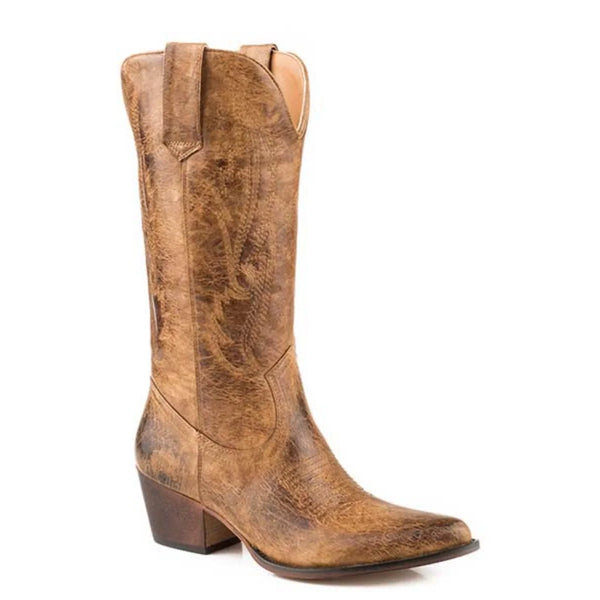
Roper Nettie Cowgirl Boot
$89.99
Floral Half Placket Collared V-Neck Blouse
$17.00
Plaid Corduroy Patchwork Flap Pocket Shacket
$24.17
Checker Side Slit High Waist Midi Skirt
$7.52
Denim Chest Pocket Drop Shoulder Hooded Jacket
$33.20
Western Desert Pearl Teardrop Saucer Dangle Earrings
$12.99Read next
More from On the Road
Snow on a Mountain Pass in May
The warning sign at the bottom, the chains behind the seat, the plow coming down, and the decision at the top.

The Best Part of a Road Trip Is the Drive Home
The return leg is where a trip across the West settles into memory — and where the holiday slips away.

Following the River Down
From a cold spring in the willows to the wide water of the basin: a day following the river downstream.