
What the Junction Store Keeps
At a junction with nothing around it, one woman's counter holds the coffee, the jerky, and every traveler who comes through the basin.
The wind came off the Great Basin all afternoon, dry and steady, tasting of dust and dry sage, and then it dropped at sunset the way that wind drops, sudden, leaving the air still and cold. The light went long and yellow across the playa. A few high clouds turned pink, then gray, and by the time I came over the last rise the basin was dark, with one lit place far out ahead of me.
That lit place was a general store at a junction. Two highways crossed out there in the empty country, and the store stood at the corner of the gravel lot like something that had outlasted what it was built to serve. A single pump sat out front with a faded sign. A pickup idled in the lot with a dog in the bed, and the dog lifted its head to watch me walk the porch.
The door opened into the warm. The room ran the length of the building under fluorescent tubes that buzzed. Everything in it was where it had been for years: shelves of canned soup, a bin of wool gloves, a rack of maps curled at the edges, and along the back wall a glass cooler running low and loud and sweating down its sides. The air smelled of dust and cedar and coffee cooked down all day. Near the counter it turned to jerky.
Behind the counter, a woman in a flannel shirt was working a crossword in a paper open on the glass. She finished a word, put down the pencil, and looked at me the way she must look at everyone who comes through that door, which is to say, without hurry.
"Coffee's on," she said.
The pot sat on a hot plate to her left. I poured a cup and tore open one of the creamer packets from a jar beside it. The coffee was strong and a little burned, warm going down, and it was exactly right. I took it back to the counter and stood there, and nobody minded that I took my time.
The Counter
By the register, a gallon jar sat with the lid propped open. The jerky inside was dark and dry, the good kind, and I thought about it the whole time I stood there. The glass case below held the things a person may realize they need at the end of a long road: aspirin, matches, a tire gauge, a spool of wire, lozenges for the throat, a small can of motor oil with rust on the rim.
The cooler along the back wall held bait. Through the fogged glass I could make out cartons of crawlers stacked against the ice, and the hum of it came up through the floor. A push-button phone sat beside the register, with a paper taped underneath in two handwritings. One said tow truck. One said sheriff.

Behind the register, a corkboard held business cards and a few handwritten signs: firewood, a lost dog, a rifle for sale. The lost dog card had been up long enough that its corners had curled. I looked at it while I drank.
While I stood there, a man came in off the dark — the one from the pickup, I figured. He wore a ball cap with something faded on the front and boots wet past the ankle.
"Dozen crawlers," he said.
The woman didn't get up. She reached into the cooler, brought out a carton, and set it on the glass. The register was an old one with a crank, and the drawer opened with a sound that filled the room.
"Creek's fishing better than the river," he said.
"It has," she said.
He paid in cash folded once, and she made the change. He nodded at me on his way out. In the lot the pickup's headlights came on, swept across the porch, and cut away up the highway.
The Company
I stayed on the stool by the counter and drank the coffee slow. The woman went back to the crossword. The only sounds were the cooler and the fan turning the postcard rack, and the particular quiet of a room where people are waiting out a stretch of road.

The wood in front of the register was worn smooth and pale, the way wood gets when many hands have rested on it. The woman knew the road. When headlights swept the window, she didn't look up; she knew what the headlights would bring, and sure enough they brought it.
They brought a young man with a flat tire. He stood in the door a moment, out of breath, and asked if there was a phone. She pushed the phone across the counter. He called someone, said "the junction, at the store," hung up, thanked her, and went back out to the porch to wait with his tire.
The next pair brought a man and a woman who had given up an argument somewhere down the road. They bought two coffees and a pack of gum and stood at the window looking out at their own headlights. When they left, she did not ask if they were all right. Not asking was part of the job, and I could see it was the part she had gotten good at.
Once a semi went by on the highway without slowing, and the window glass trembled in its frame. Neither of us looked up.
After that the road went quiet. She poured herself a cup from the same pot and went back to the crossword. I thought about the hands that had worn that counter smooth, and about the kinds of tired that must come through a place like this, and I drank my coffee and didn't say any of it.
The fan turned the postcards. Outside, the dark came right up to the windows.
Postcards
When the cup was empty, I bought a postcard. The rack held a few dozen, most of them of the basin: the playa at sunset, the mountains in deep snow, a ranch on the river. The one I picked showed the playa in the same light I had just driven through, except in the picture the playa looked like a place somebody had arranged.

There was a pen tied to the rack on a piece of string. I wrote one line about the wind and realized I didn't know what to call the place I was standing in, so I left that part blank.
I set the card on the glass. "A stamp?" I said.
She tore one from a sheet she kept in the drawer. "Watch for antelope on the road," she said when I paid.
I took the jerky too after all, one stick from the jar, and she wrapped it in a paper napkin from the stack beside the register.
"Coffee helped," I told her.
She nodded, and that was the whole exchange.
Outside, the wind had shifted and come up colder. The porch light buzzed over the door. The dog was gone from the pickup bed. I got in the car, and the headlights picked out the gravel and then the blacktop, and the store fell behind me. When I looked in the mirror, the porch light went dark, and the junction went flat against the dark.
I ate a piece of the jerky once the store was behind me in the mirror. It was as good as it looked. Then I drove the first stretch slow, watching the shoulders for the shine of eyes, and the basin opened out ahead of me under the clear, cold dark, and I drove on into it.
From the shop
Picked for this story
Short Sleeve Crew Neck with Rhinestone Tee
$12.99
Stripe Drop Shoulder Crewneck Sweater
$21.41
Western Square Concho Fashion Earrings
$15.99
Leopard Ruffle Long Sleeve Mini Dress
$23.81
Western 3-Concho Faux Turquoise Dangle Earrings
$11.99
Solid Half Zip Pullover Top and Joggers Set
$39.72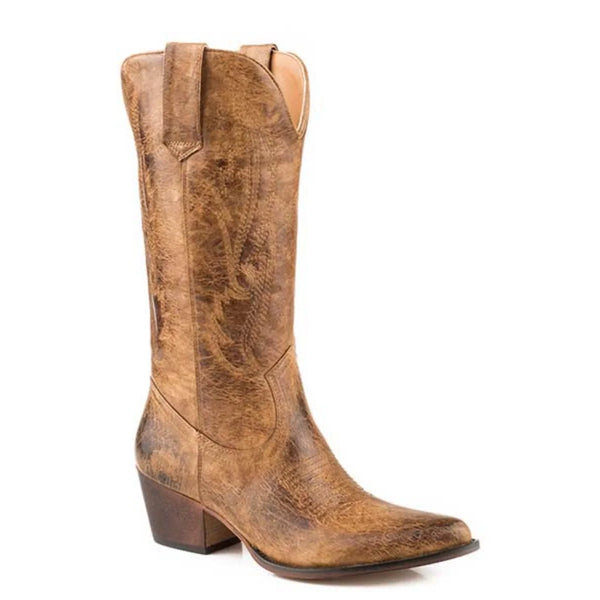
Roper Nettie Cowgirl Boot
$89.99
Leopard Contrast Trim Dolman Sleeve Sweater
$23.81Read next
More from On the Road
The Juice on the Steering Wheel
In the heat of July, the valley's cherry orchards send their fruit to the highway shoulder, and the road remembers those who stop.

The Two-Lane Arrives
The interstate saves hours; the two-lane spends them on country. They are two answers to one question.

Saturday Night at the Small Town Rodeo
The lights show up first, then the dust, then the whole town — and you are only passing through.